
Forced Deportation and Re-entry to Korea: Waiting It Out Is Not the Answer
#Deportation & Immigration Violation
#칼럼

Many people searching for information about re-entering Korea after forced deportation are either already back in their home country
or have a family member who has received a deportation order.
The first thought is usually the same — once the entry ban period is over, they can simply come back.
It is not that simple.
If an entry ban is attached to the deportation order,
a visa application may be rejected even after the ban period has passed.
And when no specific period is stated, it can be impossible to know how long to wait.
Re-entry after forced deportation is not a matter of waiting.
It is a matter of procedure.
The core reason re-entry becomes so difficult after forced deportation is
that an entry ban decision is typically issued alongside the deportation order.
The length of the ban varies depending on the circumstances —
one year, two years, three years, five years, ten years, longer than that,
or in serious cases, a permanent ban.
During this period, any visa application will be denied.
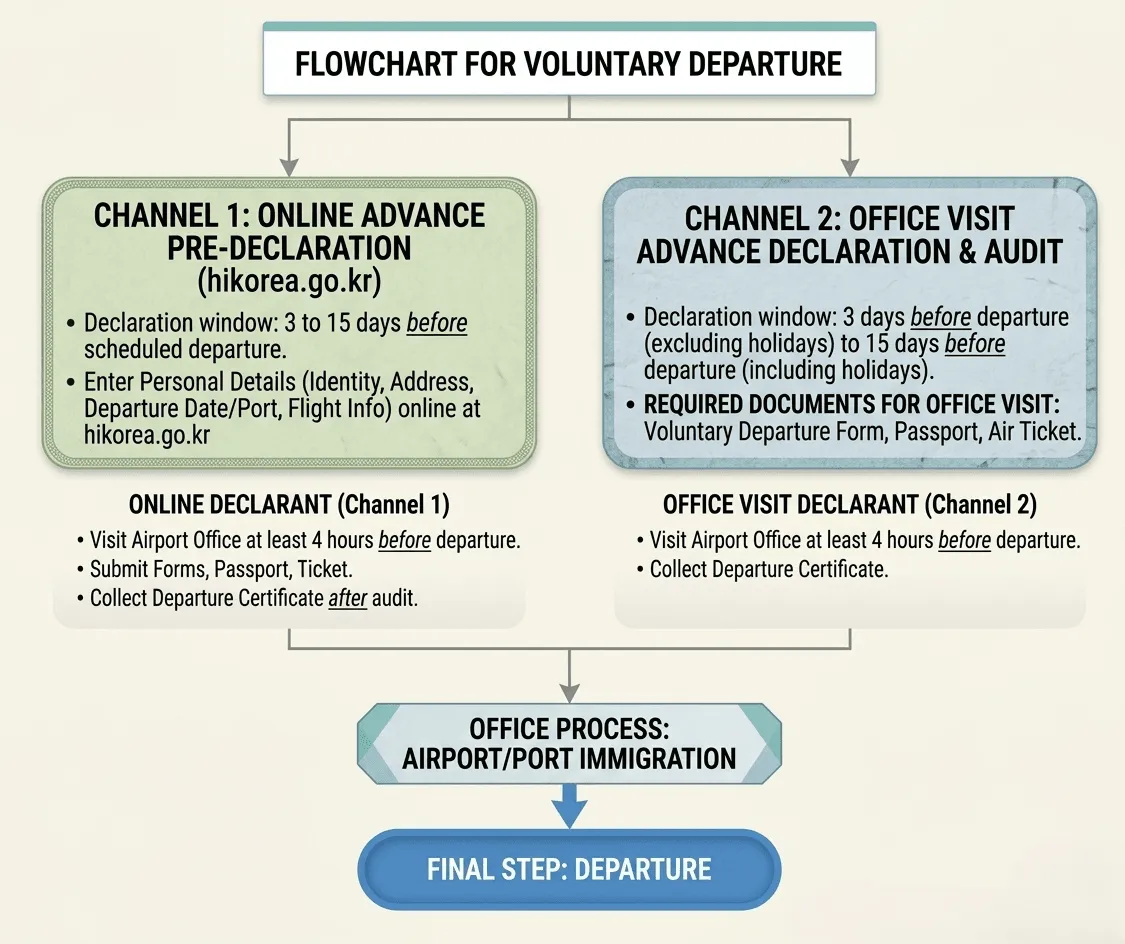
Voluntary departure is an entirely different matter.
If an undocumented person self-reports and leaves the country voluntarily,
fines can be reduced and restrictions on future visa screening may be suspended.
Forced deportation and voluntary departure may look the same on the surface,
but their impact on re-entry is completely different.
Not knowing this distinction when facing a deportation situation
can lead someone to unknowingly choose the more damaging outcome.
If forced deportation has already taken place,
it is possible to apply for the lifting of the entry ban through a Korean overseas mission.
However, the mission only receives the application —
the authority to grant or deny the request lies with the Ministry of Justice.
Simply submitting an application is not enough.
A recognized humanitarian reason must be clearly established.
The most commonly accepted humanitarian ground is having a spouse or child in Korea.
Supporting documents such as a marriage certificate, proof of family dependence, a letter of reflection,
and a petition letter must be compiled and submitted to the Ministry of Justice.
The strength of these documents determines the outcome.
A valid reason paired with poorly prepared materials will result in denial.
If there are grounds to dispute the deportation order itself,
an administrative appeal or administrative litigation can be filed within 90 days of the decision.
An administrative appeal typically takes between two and six months to resolve,
while administrative litigation takes considerably longer.
If still within 10 days of the decision, a formal objection can be submitted directly to the Minister of Justice.
Time is critical in re-entry cases after forced deportation.
The window for filing an objection is 10 days.
The window for an administrative appeal or administrative litigation is 90 days.
Once these deadlines pass, the options for challenging the decision disappear.
Having a spouse or child in Korea is the strongest humanitarian ground available,
but the outcome depends on how that ground is presented and what documentation supports it.
Simply stating that family members are present in Korea is very different
from providing a detailed and substantiated account of the dependent relationship and living situation.
These two approaches lead to very different results.
If deportation has already occurred,
identifying what legal steps are still available now is far more important than waiting for time to pass.
Re-entry after forced deportation is not something that resolves itself with time.
Entry ban lifting applications, formal objections, and administrative appeals all carry strict deadlines,
and outcomes vary significantly depending on how each step is handled.
If you need to clarify where your situation stands,
contact Maeil Law Office today.